Skip to content

SparkDog Insights

Practical advice for small business websites, marketing, and growth.

5 Key Advantages of Hiring a Web Designer

As a small business owner, you juggle countless responsibilities—CEO, CFO, and even custodian.  With so much on your plate, it might seem tempting to manage your website yourself.  But when it comes to creating or redesigning your business’s online presence, partnering with a professional is a game-changer.  That’s where SparkDog Creative comes in.


We understand the unique challenges small businesses face.  Whether you have a clear vision for your website or no idea where to start, we’re here to make your life easier and help your business thrive.  By choosing us, you’re not just getting a website; you’re gaining a partner dedicated to your success.

Here are five key advantages of hiring SparkDog to manage your website needs:

1.  Save Time

Your time is precious.  As a small business owner, every minute counts, and spending hours figuring out website design and technical details isn’t the best use of your resources.  Hiring a professional web designer lets you focus on what you do best—running your business—while we take care of your website.  We manage everything from updates and changes to troubleshooting, so you don’t have to.

2.  Save Money

Saving money is just as important as saving time.  While DIY website builders might initially seem cost-effective, hidden fees and the time investment can quickly add up.  Plus, a DIY website often needs more professional polish to make a real difference in attracting customers.  We offer professional websites that look like they cost a fortune—but at a fraction of the price.  Our affordable packages ensure you get the best value without breaking the bank.

3.  Get Better Results

When it comes to your online presence, quality matters.  A website should be a digital reflection of your business, and a professionally designed site can elevate your brand far beyond what a DIY solution can offer.  With SparkDog Web Design+, your website will be optimized for search engines, mobile devices, and user experience.  The result?  A website that looks great and performs exceptionally, helping you attract and retain customers.

4.  Experience Matters

Building a successful website requires more than technical skills; it requires experience and industry knowledge.  We bring years of expertise, staying ahead of industry trends and ensuring your site is always up-to-date.  From SEO strategies to eCommerce integration, we know what works and how to implement it effectively.  We can create a site tailored to your business that is fully optimized and secured with SSL certificates.

5.  Outside Perspective

An outside perspective can be invaluable when it comes to your website.  As professionals who aren’t as close to your business as you are, we can offer insights that might otherwise be overlooked.  This allows us to create a website that reflects your brand while focusing on what matters most to your customers.  With SparkDog, your website will be cohesive, professional, and geared toward growth.

Hiring SparkDog Creative is an investment in your business’s future.  We save you time, money, and the stress of managing your website, all while delivering a product that elevates your brand and keeps your online presence at its best.  Let us manage your website so you can focus on what you do best—growing your business. less

5 Reasons Why Your Business Needs a New Website Before the Busy Holiday Season

It’s no secret that Thanksgiving to New Year’s Day is many businesses’ busiest time of year. But did you know how well a business performs during the next few months can mean the difference between turning a profit or a loss for the entire year?

What might be more surprising, though, is that the holidays are a great time to invest in a new website. While taking on another project during the busy season may seem counterintuitive, it will help set your business up for success during the holidays and beyond.

The holiday season brings lots of new shoppers and potential clients. So, now’s the perfect time to ensure you have a website that can do all it can to attract them. Here are five reasons businesses need new websites before the busy holiday season.

1. A website can help you maximize holiday sales.
The holidays are always a busy time for businesses. Everyone from restaurants to retailers sees an influx of customers from November through December. A website allows businesses to increase revenue even further during this busy time of year.

Businesses can use their website to promote holiday specials and seasonal offers to their customers. Restaurants can offer online ordering for customers too busy to cook or looking to cater for a holiday get-together. Retailers can use their website to highlight popular items, suggest gift ideas, or launch an online store. No matter how you use it, having a new website is a fantastic way to attract more customers and maximize sales during the holidays.

2. A website can help streamline operations and ease your staff’s stress during the busy season.
Instead of keeping an employee on phone duty all day, juggling multiple impatient callers, answering the same questions repeatedly, and trying to shout over the noise of your busy business, you and your team can utilize a website to serve customers better. Alleviating this stress creates time for your team to serve customers better and enhance the shopping experience.

Imagine your company website as the perfect employee. It’ 's always on time, works 24 hours a day, 7 days a week, provides accurate information, and consistently positively promotes your brand. Your website works for your business even when you close and go home. It allows customers to connect with you anytime from anywhere, providing a cost-effective and reliable salesperson for your business 24/7. Why spend thousands of dollars more monthly in payroll when you can invest a fraction into a new website?

3. The holidays are the perfect time to promote your new website.
It’s essential to make your customers aware of your new website and all the features and benefits it offers them. You’ll want to spread the word about your new website in-store and online.

Promoting your new website is a terrific opportunity when your business is busy with shoppers during the holiday season. Make the most of this valuable exposure and get your customers excited about your new online presence. Consider using these marketing tactics:
·        Add in-store signage that promotes your new website.
·        Place postcards in customer shopping bags or keep a stack by checkout.
·        Get promotional products like pens or calendars made with your website URL and hand them out to shoppers during the holidays.
·        Entice customers to visit your website for a special coupon or offer.

4. You can use the holiday rush to gain valuable insight and customer feedback.
A website can do more than promote your business or generate sales. It’s also a great way to gather customer feedback and valuable data to build loyalty and improve customer experience.

You can use your website forms to collect customer feedback and their recent experience. The holiday rush also gives you a jump start in building your customer database by encouraging website visitors to sign up for an email newsletter. This data will be helpful during the busy season and even after holiday sales subside.

5. You’ll be better prepared to combat the January Blues.
While the holiday season is the busiest time of year for most businesses, the first few months following are typically the slowest retail months. For many businesses, the “January Blues” are real and kick in the first week of the new year. Sales quickly slow down, and stores can empty out.

Rather than putting it off until after December, launching your website during the holiday season can help you maintain healthy sales and keep your customers back throughout the following year. You can email your customers an enticing reason to visit you or order online. You can use your website to promote after-holiday deals and discounts to combat slow or stagnant sales. And you can use the feedback you collected during the holidays to make in-store changes to better serve your customers. There are plenty of ways to keep the momentum going by leveraging your new website as a year-round
marketing tool.

Don’t wait - get a new website for your business today!
While the thought of getting a new website launched before the holidays might sound overwhelming, it’s completely doable and worth considering. Remember, the holidays only come once a year, so you don’t want to miss the opportunity to capitalize on them and maximize sales. A website will also better position you for the slower months after the holidays.

In short, you’ll thank yourself in the coming months if you launch your new website today. less

5 Things Your Website Is Secretly Saying About Your Business

Your website talks — even when you’re not around.

The question is, what is it saying about your business?

Here are five silent messages your site might be sending (and how to make sure they’re good ones).

 “I’m Outdated — Maybe My Owner Is Too.”
If your website looks like it time-traveled from 2010, visitors might assume your business is behind the times, too.

💡 Fix it: A clean layout, readable fonts, and updated photos instantly say “We’re current and professional.”

“I Don’t Care About Details.”
Broken links, typos, and fuzzy images whisper “close enough.” That’s not the impression you want.

💡 Fix it: Check your site monthly. A quick polish shows you care about quality and follow-through.

“I’m Hard to Talk To.”
If visitors can’t easily find your contact info or have to jump through hoops to reach you, they’ll move on.
💡 Fix it: Keep your phone, email, and social links front and center — like an open door to your business.

“I Don’t Know Who I’m Talking To.”
When your message tries to speak to everyone, it connects with no one.
💡 Fix it: Write like you’re having a real conversation with your best customer. Use their language, not tech-speak.

“I’m Invisible.”
Even the prettiest site won’t help if no one can find it. If you’re not showing up in search results, you’re whispering into the void.
💡 Fix it: Add keywords people actually use, keep your Google Business Profile up to date, and post new content regularly.

✨ BOTTOM LINE:
Your website is your digital storefront — it tells your story 24/7. Make sure it’s saying all the right things.

7 Reasons Why Small Business Websites Are Vital

A website is a vital component of a small business’s success. However, not any website will do. About one in five small business websites struggle to generate traffic to their website. Meanwhile, 57% of users won't recommend a company with a poor mobile web design. If your website doesn't offer a positive experience, you could lose potential customers.

With our affordable website design services, you can stand out from competitors, generate awareness, and attract fresh leads and sales.

On the fence about investing in your business website this year? Read on to discover the top 7 reasons why a strong website is beneficial to your company's success today!


1. Keep Your Doors Open

Most retail businesses only stay open for part of the day, not 24/7. Each day your brick-and-mortar store's doors close, you miss opportunities to make sales. Your business website can keep your virtual doors open at all times.

Marketing your business around the clock will help you appeal to a wider audience of customers. Consumers can visit your website to learn about your business, mission, and offerings. If you have an e-commerce website, you can even make sales when your store is closed.

You can maximize sales by using your business website as the foundation of your overall marketing strategy.

For example, you attract visitors to your website using Google, social media, and other online platforms. Consumers can learn about your business from each touchpoint to decide if you align with their needs. Then, you can use a call-to-action on your website to turn those visitors into leads or sales.
In addition to adding eCommerce abilities to your website, you can also use an online form or chatbot to boost conversions.

Having a website benefits your overall marketing and sales objectives, allowing you to grow your business.


2. Generate Awareness

If consumers don't have a way to discover or learn about your business, you won't generate sales. Small business websites allow consumers to learn about the different options available.

As the foundation of your digital marketing strategy, you can use your website to generate awareness for your brand. Each time someone interacts with your brand, they'll have an easier time remembering who you are and what you do. However, it can take five interactions before someone recalls your business.
Learning about your business can also help people feel more comfortable with your brand. In fact, 82% of consumers feel more positive about a brand after reading personalized content. Over 60% are more likely to buy from companies that deliver unique content, too.

Consider working with our website design agency this year. We can infuse your visual brand across every page of your website.

In time, brand awareness will grow until consumers can recall your brand or associate it with your products and services. The next time they need your offerings, they'll think of your brand first. Then, you can generate leads and sales to help your business grow.


3. Convey Your Expertise

Remember, consumers feel more comfortable with businesses after reading personalized content. You can use your business website to share helpful, informative blog posts.

It’s important to work with a website design agency that can design and optimize your website for search engine optimization (SEO). SEO can help more people find your website and content. Then, you can start communicating your experience and expertise.

You could even position yourself as a thought leader in your industry. Becoming a thought leader can help you prove your credibility. Gaining credibility could encourage more people to trust your brand.

As people learn to trust your brand and expertise, they might rely on you for the products or services they need. You could have an easier time attracting new customers as a result.


4. Boost Your Rankings

In order to reach more people online, it helps to create an SEO marketing strategy. SEO will help your business appear higher on search engine result pages (SERPs). When someone searches for your product or service, your website might appear at the top of a SERP.

Appearing at the top of SERPs for different searches can help you rank ahead of competitors. In fact, small businesses can rank ahead of huge corporations using SEO. You can even the playing field to attract new people to your business.

Boosting your rankings will also help you generate more website traffic. Remember, as people visit your business website, they can learn more about your brand.

As you attract new visitors, you'll gain more opportunities to generate sales. Since SEO is a cost-effective marketing strategy, your ROI will improve over time, too.


5. Generate Loyalty

As people begin to trust and fall in love with your brand, they might become long-term, loyal customers. Encouraging brand loyalty will help you generate repeat sales.

You can spend less money on advertising and customer acquisition, allowing your ROI to improve.
You can even use your business website to host a brand loyalty program to encourage more people to make repeat sales.


6. Show Off Products

Consumers want to learn about your products and services. Our affordable website design services can help you show off your offerings.

Consumers will have an easier time recognizing the benefits and features you offer. You could have an easier time communicating your unique value proposition to stand apart from competitors.

If you accept online sales, you can even use your website to sell more products than ever before! For small businesses that book consultation appointments or reservations, consider using a scheduling app instead.

Either way, you can customize your website based on your needs to grow your business.


7. Gather Helpful Data

One of the top website benefits you'll experience is the data you can collect from your company website. You can use this data to learn:
 

  • What demographics your customers fall under
  • Which pages they visit
  • When they leave your website
  • What blog posts they read
  • Which products/services they prefer


The more data you gather, the more likely you are to improve your digital marketing strategies. You can then generate more leads and sales to boost your ROI!


Small Business Websites are Vital: Invest in Affordable Website Design Today

Set your company up for success this year. Contact us to learn more about our affordable website design services for small businesses. With help from our website design agency, you can reach more customers online than ever before.

Leveraging our agency's experience and expertise will help you save valuable time and energy.

Eager to get started? We can't wait to help.

Let us build a website for your business. Get started with our professional designers today.

7 Signs You Need a New Website for Your Business

The first and oldest web domain on the internet is symbolics.com, founded in 1985. And even they updated their look and feel to keep up with modern search and user trends.

Web design might sometimes seem like an unnecessary expense for some small business owners. In fact, it's quite the opposite. User habits and Google search algorithms change regularly. You're missing out on valuable traffic (and potential customers)  if you're not consistently modernizing your website.

But how do you know when it's time to upgrade—or build your first site? Below, we highlight 7 signs or reasons a small business needs a new website.

Read on to see if they apply to you!


1. You Still Don't Have a Website
Shockingly,
 a large number of small businesses in America don't have a website at all.

It might be okay if your business is an independent gas station in a high-traffic area, but it poses a significant problem for anyone else. You're missing out on many potential leads if you don't have a website.

Thankfully, this is a problem that you can resolve quickly. There's never been a better time to access affordable web design. Today, websites are reasonable to host, affordable and quick to design, and easy to maintain—so long as you
 collaborate with a savvy provider.


2. Your Current Website is Ugly or Outdated
The adage goes: Never judge a book by its cover. Well, that doesn't work so well when it comes to your online presence.

The main goal of your website is to attract and engage visitors, encouraging them to interact with your website the way the entity hosting the website needs them to. This might be to buy a product (an e-commerce business), request a service quotation (a plumber or roofer), or make an appointment (a doctor's office). However,
 one study found that close to 40% of visitors will discontinue their time on a website if they think it's, well, ugly.

So, if your website looks like it's from 2013 instead of 2026, it's time to invest in a website redesign—ASAP!


3. Your Website Is Not Mobile Friendly
You're probably glued to your smartphone. After all, the average user spends
 over 3 hours A DAY scrolling socials, websites, emails, podcasts, and more on their phone.

Well, it's not a wild assertion to suggest your customers are doing the same thing. And you need to make sure your company website works great on a desktop and adapts to the smaller screens people now use.

And that's because nearly
 60% of web traffic comes from a mobile device—a smartphone, tablet, or laptop.

Thankfully, most website builders today use responsive design technology, making it easy to adapt to this new reality.


4. You're Not Getting the Results You Expect From Your Site
You've nailed that all-important first impression. Your website looks great on mobile. Yet, you're still not attracting those all-important leads—at least, not as many as you'd hoped.

If your conversions are low, it could be because your website design isn't optimized to aid your customers' journey through your
 sales funnel. They might find you, but once they're on your site, they're getting lost in where to go or what to do next.

A redesign with a focus on clear calls-to-action can help you achieve your conversion goals.


5. Business Is Slow, and Sales Are Stagnating
You've had a legitimate business for a long time, and once, your website served you well. People could find you, and they'd contact you via phone or the contact form on your website to enquire about your services.

Today, those people just aren't coming. So, what's going on?

Your aging website is likely not optimized for inbound marketing. You must ensure it includes places where you can provide your visitors with educational and helpful information that addresses their pain points and helps them trust your expertise.


6. You Have a High Bounce Rate
Google Analytics defines a bounce rate as the percentage of people who visit a single page on your website. This essentially means the analytics program is counting the number of people who only stay on the website they first click through to—say, from the Google search results page—and then click away from your website immediately or a short time later.

A high bounce rate is considered anywhere between 
56% to 70% (or above). You can read this as your website not having enough relevant content to keep visitors interested and exploring.

To remedy this, you need to upgrade your website, so it offers people somewhere to go next at all stages of their experience.


7. Your Website Isn't Secure
If your website fails on security, it will get downvoted in Google searches. And this means no one will find you. Also, if visitors perceive your website as unsafe, they're unlikely to trust you.

Modern websites need an SSL certificate at a minimum. This is a fundamental trust signal for visitors and Google. However, some small businesses may need to consider upgrading to something even more encrypted, especially if they collect personal client data.


We Build Small Business Websites That Work
If you think you need a new website, trust your gut. If it's telling you "yes," you needed to invest yesterday. If even one of the points above resonates with you, it's time to invest in an upgrade.

Your customers complain they can't find what they need on your website. Maybe you're worried clients aren't finding you online at all! Can you navigate properly or upload updated content onto your website?

Contact our agency to discuss your new website today. We specialize in affordable web solutions and small business websites that are effective, optimized, and secure.

8 Marketing Mistakes Small Businesses Make

A recent study found that 50% of consumers believe that website design is a fundamental factor in a business’s brand. Website design showcases your business’s style, attitude, and aesthetic.

However, small business websites aren’t forever. They need to be updated and redesigned just like any part of your business.

To help you, we’ve investigated everything you need to know about redesigning your website. That way, you can decide if your website needs to be redesigned or if it’s perfect the way it is.

Now, are you ready to get started? Here’s an in-depth look at website redesign:

Why Is Resigning Your Website Important? 

Redesigning your website helps improve viewers’ impression of your overall business. If the load time is slow or not mobile-friendly, some viewers may get frustrated.

Do you want your viewer’s first thought in relation to your company to be one of frustration? No, you want viewers to be intrigued, curious, and engage with your brand.

So don’t give viewers something to dislike before they get to your page. Redesigning your business website will help it stay trendy and up-to-date. That way, customers see your brand for what it has to offer.

When To Redesign Your Website 

Are you questioning whether your website needs a redesign, but aren’t sure it’s the right time? Don’t worry; below, we’ve listed a few signs that your website is due for a redesign:

Website Loading Speed Is Slow or Isn’t Mobile Friendly 

If your website has a slow loading speed, that’s a sure sign that your website is out of date. Visitors expect the loading speed to be a
 maximum of 2 seconds; any longer will cause frustration and may lead visitors to exit the page.

If you want visitors to stay on your website, you must have a responsive and mobile-friendly design. Your website should automatically scale its content, photos, and video graphics, and navigational buttons to the visitor’s phone screen size. If your website fails to do this, the visitor will not only be annoyed but also think your company is outdated.

Thus, first impressions matter, especially when it comes to website design. Studies have shown that it only takes a visitor 0.5 seconds to decide if they will stay on the page. So if your website suffers from slow loading time or doesn’t have a mobile-friendly design, a redesign is needed immediately.

Your Website Lacks On-Page SEO  

Even if your website is responsive and professionally designed, it won’t benefit you if you lack proper optimization. Your website needs to have search-engine-optimized keywords that will pull your website to the forefront of Google searches. If you don’t, you’re making your website hard to find, decreasing traffic, and reducing customer conversion.

A redesign is crucial for the success of your website. When redesigning, make sure you update the landing page to have
 optimized keywords and always have a call to action.

You Have Low Conversion Rates 

If your website continues to receive traffic but has a low customer conversion rate, there’s a problem. Your website is obviously easy to find, but somehow, it’s lacking something visitors want. Whether it be a clear understanding of your product, more payment methods, or interesting photos, there’s a reason visitors aren’t converting to customers.

Keep in mind that a good website achieves your marketing goals. This means that your website should motivate visitors to explore your services, buy your products, or contact you. If your website doesn’t fulfill your marketing goals and isn’t converting customers, a redesign is a must.

Content Is Not Relevant 

When was the last time you updated the content on your website? If the answer is over a year, then your website is due for a redesign. Studies show that over 71% of business owners redesign their websites after a year or two.

After all, your website is only as good as the content it displays. If you’ve recently changed your business address, business hours, or prices, they should be accurately reflected on your website. Not updating your website will confuse visitors and make the purchasing process much more difficult.

The Website Design Looks Outdated 

Trends come and go, and as such, what’s seen as sleek and modern changes with the year. If your website uses a chunky or older template, then it’s time for a redesign.

Lately, websites that use negative space, intriguing transitions, and simple layouts get the most views and page time. So you’ll want to update your website to adhere to these new standards if you want to increase your views, page time, and customer conversion rates.

You’ll even want to be creative on your website and introduce your brand in a way that pulls the customer in rather than just stating facts. A good web designer can help you do just that.

Is it Time to Redesign Your Small Business Website?

Redesigning your website is often a hard decision. However, your website must be updated for visitors to look at and engage with. If your website is not mobile-friendly, lacks proper optimization, or is not relevant anymore, a redesign is needed.

Thankfully, our team can help you redesign your small business website, so you can successfully reach more customers. We do it all, whether it’s helping you refresh the design or giving your site a complete overhaul.

If you’re still unsure if you need to redesign your website,
 contact us today for a free consultation, and we’ll help you decide what’s best for your website.

8 Reasons Why a Mobile-Friendly Website is MANDATORY for Small Businesses

On making purchases and searching for information, almost 60% of all online searches are now conducted on mobile devices. For specific industries, such as food and beverage, that number can go as high as 72%.


With a high volume of searches on mobile devices, it’s clear why a mobile-friendly website is essential for businesses. Without one, companies risk missing significant web traffic and potential customers.
 

Why a Mobile-Friendly Website is MANDATORY


1. Improves SEO Ranking

A mobile-friendly website helps improve SEO ranking. Mobile-responsive sites are more likely to rank higher in search engine results pages. Search engines like Google reward websites that provide relevant and reliable information with higher rankings.
 

2. Increases Visibility

Mobile-optimized websites allow businesses to reach a wider audience, enhancing visibility and growth. Mobile users can significantly impact brand awareness by posting reviews and sharing content on social media. Mobile commerce sales reached nearly $2.2 trillion by the end of 2023, highlighting the importance of having a mobile-capable website.


3. Improves User Experience

User experience is crucial for every small business website. A mobile-responsive website makes it easy and convenient for visitors to find information and make purchases. A good user experience can influence whether a consumer revisits the site or goes to a competitor.


4. Ease of Use

A mobile-friendly website is easy to use. Mobile devices allow users to search for anything anytime and anywhere and view websites in landscape or portrait mode for the best experience. Modern mobile-friendly website designs offer a familiar and comfortable format for users.


5. Competitive Advantage

Having a mobile-friendly website gives small businesses a competitive edge. It allows them to stand out from competitors, grow their audience, and increase sales. A mobile-responsive website design is crucial for an effective online presence and provides valuable data for better customer service.


6. Flexible Communication

Mobile-friendly websites offer flexible communication systems, allowing businesses to reach their target audience more efficiently. Responsive websites have chat systems that connect from the mobile site to a phone or desktop, making it easy to assist site visitors quickly.


7. Builds Trust and Credibility

A solid online presence is essential for building trust and credibility. Mobile-friendly websites simplify things for customers across various industries. A website that isn’t mobile-optimized can jeopardize a small business’s credibility.


8. Gives a Modern and Relevant Look

Mobile-friendly websites are the new normal. In our digital age, users want quick information and a pleasant experience. A modern and relevant look will excite users and encourage them to return and become loyal customers.


Optimize Your Mobile-Friendly Website Today!


Mobile-friendly websites are essential to any small business marketer’s plan. They offer ease of use, flexible communication, and help build trust and credibility. Thankfully, creating a mobile-friendly website doesn’t need to be complicated. SparkDog Creative websites are customized for desktops, tablets, and smartphones right out of the box, saving you time and money without sacrificing quality. less

8 Things Every Small Business Website Needs

If you run a small business, no matter what it is that you do, or where you’re located, you need a website. Small business websites are crucial for online visibility, branding, and driving sales, but only if you've got good web design.

To make a high-quality website for your business, you need to know what core features to include. This post will discuss some of the most essential elements that should always be at the forefront of your small business website design.

Whether you’re launching your first small business website or going through a rebrand, your website has to be perfect. Keep reading, and we'll show you how to make it happen.


1. Good Domain Name

Your web address is as important as the address at your brick-and-mortar location. It should be concise and easy to remember, but descriptive enough to give a sense of what you do.

A domain name should also be easy to spell. If your visitors misspell your web address, you risk losing out on leads and customers. Registering your domain is the first thing that you'll do when you start your business website, so take your time and come up with an original domain that you'll have for years to come.


2. Professional Design
First impressions matter, even when people are looking for your business online. The best way to make a good impression on your visitor is to have a clean,
 professional-looking website that shows them what you do.

When it comes to design, having visual elements that represent your brand and what you offer is important. Including eye-catching images and videos on each page of your site will ensure that you hold their attention throughout their visit.

You have to strike the right balance between functionality and attractiveness, however. If you include too many images or videos, you risk slowing your page load times. When your site takes too long to load, you're going to lose people.


3. Easy Navigation
Clarity is an underrated aspect of website design, but something that is essential to user experience (UX). When a consumer visits your website, you've only got a few seconds to capture their attention. Without simple and effective navigation that accounts for UX, they'll go elsewhere.

To make a user-friendly site, you have to think like the consumer. Most likely, they're on your page because they're looking for products or services that you offer. It should always be easy to find this type of information with a few quick clicks.

The way you set up your menus and landing pages determines how navigable your site will be. Navigation should be clear and to the point. If you've got a confusing website, it's failing you and your customers.


4. Mobile Friendliness
Around
 70% of web traffic these days actually comes from mobile devices. For that reason, your online platform had better be responsive to any and every mobile device.

Create a mobile-optimized site by experimenting with things like page size and menu formats. Navigating a mobile site should be simpler and more to the point than a desktop one. A good web designer will understand this and work with you to ensure that your mobile site is bringing people in, not driving them away.


5. Clear Calls to Action
Each landing page on your site should have a call to action that urges your visitors to do something specific. The action could be anything from filling out a contact form to signing up for your company newsletter. The call should be a simple and persuasive statement that makes it obvious what you want the customer to do next.

Put some thought into each action that you want the customer to take and how you can word your CTA. CTAs should have an immediate impact on lead generation and revenue, so experiment until you start to see tangible results.


6. Search-Friendly Content
Strong search engine optimization (SEO) is an important byproduct of having a good website. When your website
 appeals to SEO criteria, you'll rank higher on Google searches. You always want to be the business that shows up on the first page of the SERP.

There's a lot that goes into SEO, but one of the most important things has to do with your content. Search-friendly content uses the right keywords for your niche, but the content has to engage the reader as well.

With a steady stream of entertaining and informative content, you'll make an impression on your visitors and give them a reason to come back. You can also inject CTAs in your content to direct them to other landing pages.


7. Accessible Contact Info
Never make it difficult for people to contact you. Your site should have a separate tab that takes them to a contact page, complete with your address, phone number, email, social media accounts, and a lead generation form.

Make sure to refer to and link to your contact page as much as possible on other landing pages as well. You can even take it a step further and put contact info in the header, footer, or sidebar of other pages.


8. Testimonials

90% of customers trust reviews and testimonials more than what a business says about itself. It's important to include a testimonial section on your website so new visitors can see what other customers are saying about you.

Anytime you have a happy customer, urge them to leave you a positive review to use as a testimonial. Not only is this going to help build trust with new customers, but the more reviews you have on other listing sites, the better it is for your SEO ranking.


Need Help With Your Small Business Website Design?
Now that you know what aspects of web design are most crucial for small business websites, it's time to discuss the importance of a professional web designer. A good web design company will ensure that your business site is helping you instead of hindering you.

At our agency, we make beautiful small business websites that are SEO-optimized, mobile-ready, and offer real-time traffic stats. The best part of it all is that we offer a 100% satisfaction guarantee.

Our process is simple. First, we learn a bit about your business, then we start working on your design ASAP. Once you approve the design, we connect you to your domain and start helping you complete and launch your site.


Contact us today to learn more about our process and to get started on your new business website.

9 Common Website Traffic Stats Explained

There are over 5.07 billion daily Internet users in the world, so there's a large base of potential customers you can reach with your website. But before you can tap into that potential, you need to know whether your website is capable of attracting those visitors. Your website traffic stats are a good place to start.

These are the numbers that show how many people visit your site and what they do while they're there. Web stats can help you see how well your marketing efforts are working. You can gauge whether they're generating traffic or not.

But these metrics are only useful if you know how to interpret them. Read on for a breakdown of the most important website traffic stats and what they mean for your business.


Why Are Website Stats Important?

Your website stats will tell you a lot about how your business is doing. They can help you see if anything needs to be improved on the website itself. Maybe people aren't sticking around long enough to read an article or watch a video, which means they won't be able to discover other interesting content.

These stats will help you figure out what needs to be done so your website can lead to more conversions.


Website Traffic Stats Explained

If you want to improve your website and attract more visitors, then understanding how it's currently performing can help you make the necessary adjustments. You can gather website statistics from various sources. The metrics below are among the most common.


1. Unique Visitors

Unique visitors is a metric that shows the total number of new users who visit your site. It doesn't include repeat visits from the same person. If you visit a website 10 times over the course of one day, then that counts as 1 unique visit.

Even if you visit the same site two or three days later, it would still count as one unique visit because unique visits are counted within a 30-day window.


2. Website Visits (Or Sessions)

Programs count website visits when a user requests a page from the server. This will generate one visit.

Every time someone visits your site and clicks on something to load another page, this counts as another visit. If someone goes to your site 48 times over the course of 30 minutes, you'll have 48 visits recorded.

A session is the time a user spends clicking around on your website. This number is important for marketers because it helps them measure engagement.


3. Total Page Views

Total page views are the total number of times that any page has been viewed from your site. This can include both single-view and multiple-view visits. If someone comes to your site and views 10 pages in one visit, they'll get counted as one visitor, but 10 total page views.


4. Pages Per Visit

Pages per visit is a metric that measures how engaged your site's visitors are with your content. It's calculated by dividing the total number of page views by the total number of visitors.

A high pages-per-visit (P/V) ratio is an indicator that people are spending more time viewing and interacting with the content you've created. That's good news for you because it means your website is effective at converting visitors into leads or customers.


5. Average Time on Site (Or Average Session Duration)

The average time on site is the average amount of time people spend visiting your website. It's calculated by dividing the total time spent on your website by the number of visitors.

A high average is an indicator that people are spending a lot of time interacting with your content and not just clicking through quickly. If a visitor spends an hour on your site, there's a good chance they'll be interested in what you have to offer as opposed to if they only look at it for 30 seconds.

The average session duration is about one minute, regardless of industry.


6. Bounce Rate

The bounce rate measures the number of visitors who leave a website after viewing only one page. It tells you whether people are engaging with your webpage's content. It's also an indicator of whether users are finding what they're looking for.

A bounce rate under 40 percent is great and means that your website is attractive and engaging.


7. Mobile Site Visits

When a user accesses your website using a mobile device, this is mobile traffic. Mobile traffic is important because it accounts for more than half of all internet usage.

If you notice that your mobile site visits are low, check to see if the website loads fast on phones and is designed for small screens.


8. Inbound Links

Inbound links are external hyperlinks that point to your website. Links from other sites to your own are a sign to Google that you're a reputable source of information. As such, you'll be rewarded with higher placement in search results.

That being said, not all backlinks are equal. While each one counts toward your SEO ranking, not all inbound links will give you the same boost as others.


9. Traffic Sources

Traffic sources are the channels that bring visitors to your website. They can be broken down into two categories, organic and paid.

Organic traffic is free and comes from search engines like Google, social media like Facebook and Twitter, email campaigns, or anything else that's not paid for by you. Paid traffic can be anything from PPC ads on search engines to campaigns on social media platforms.


Create a Website That's Designed to Attract Visitors

Your website traffic stats are an important part of your SEO. If you want to improve your metrics, then it's important that users can easily navigate your website and find what they're looking for. To do this, you need to have a clean design with plenty of white space and clear navigation menus.

As you can tell, creating a professional-looking website is not as easy as it sounds. Why take on the hassle when our agency will do it for you? Contact our team of designers today to learn more about how we can help you build an impressive website that drives traffic.

Artificial Intelligence Website Security - The Risks No One Talks About (And How to Protect Your Business)

AI can build a website fast. But can it keep it safe? 🔐


AI website builders feel like magic. Type a few prompts, click a button, and suddenly you have a polished website. For solo business owners, creatives, and small agencies, that speed is incredibly appealing — and sometimes, it’s exactly what’s needed.

But here’s the uncomfortable question most people don’t ask until something goes wrong:

👉 Is that AI-built website actually secure?
A website isn’t just visual decoration. It’s your digital storefront — the place where visitors trust you with their contact details, messages, and sometimes payments. One weak spot can lead to lost leads, SEO problems, frustrated customers, or a site that suddenly goes offline. Speed is exciting, but security is what keeps things standing once real people start interacting with your site.

🚨 Why AI Website Security Is Becoming a Real Issue
Most AI website tools are designed for rapid deployment. Speed is the priority. Security, which requires planning and ongoing attention, often comes second.

Think of it like setting up a pop-up shop. You can open quickly with a table and a sign, but locks, alarms, and insurance take more thought. AI platforms excel at generating pages, images, and copy, but they often overlook long-term protection.

Bottom line: speed is built into AI.  ⚠️ Security usually isn’t.

🕵️‍♀️ Five Security Risks Hidden Inside Many AI Website Builders
These problems rarely show up on day one. They appear later — when traffic increases, forms fill up, and customers expect reliability.

🧱 1. Shared Hosting That Puts You at Risk
Many free or low-cost AI builders place thousands of websites on shared servers. Your site isn’t fully isolated. That means someone else’s compromised site or mistake can affect yours, even if you’ve done everything “right.”
You’re sharing space — and risk — with strangers.

🔒 2. SSL That’s Optional (It Shouldn’t Be)
SSL is what gives visitors the lock icon in their browser. Without it, browsers warn users that your site isn’t secure. That alone can reduce form submissions, harm search rankings, and expose data during transmission.

Some AI builders charge extra for SSL or limit it to certain pages. For a business website, treating SSL as optional is an unnecessary gamble.

 3. Slow or Inconsistent Security Updates
Online threats change constantly. Platforms need to update defenses just as quickly.

AI-first and free tools often focus on launching new features instead of maintaining existing ones. When security updates lag, attackers don’t wait — they move in first.

Security isn’t a one-time setup. It’s an ongoing responsibility.

📦 4. Vague Data Handling
With many AI builders, it’s unclear where your data is stored, what happens to form submissions, or how customer information is protected.

Ask yourself this:

👉 Do you know where your customer form data actually goes — or who can access it?
Uncertainty is a risk, especially for businesses managing client or customer information.

🆘 5. No Help When Something Goes Wrong
This is often the most painful issue. When a free or automated tool fails, support may be slow, limited, or nonexistent. Responsibility is unclear, and you’re left explaining the situation.

Clients don’t blame the platform.  ❌ They blame the website owner.

🧠 Why Website Security Matters More Than Ever
Modern websites do real work. They collect leads, handle communication, support sales, and represent your brand around the clock.
A security issue doesn’t just look like a technical problem to visitors.  👉 It looks like carelessness.  And trust, once broken, is hard to rebuild.

 What Responsible AI Website Platforms Do Differently
More thoughtful platforms treat security as a baseline, not an upgrade. That means protections are built in by default, standards are clearly defined, monitoring is ongoing, and accountability is real.
AI should simplify work — not quietly introduce new risks.

🛡️ How SparkDog Approaches AI Website Security
SparkDog uses AI to accelerate website creation without replacing human judgment. Security isn’t an add-on — it’s the foundation.
That means SSL is included by default, secure hosting environments, and human oversight instead of a “set it and forget it” approach. The goal isn’t just fast websites, but websites that remain dependable, secure, and trustworthy over time.

🤖 AI Isn’t the Problem — Unmanaged AI Is
AI excels at speed and efficiency. What it doesn’t do well is assess risk, monitor threats, or take responsibility when something goes wrong.
That’s why the platform — and the people behind it — matter more than the tool itself.
The future of web design isn’t AI-only.

🚀 A Thought to Leave You With
AI has made building websites easier than ever — and that’s a good thing. But when real businesses, real customers, and sensitive data are involved, security cannot be an afterthought.

Speed is easy to achieve.  Real security is intentional.

If you’re using AI to build or manage websites, it’s worth asking whether the system behind the technology is actually designed to protect what you’re creating. And if you ever want a second opinion, SparkDog is available to offer practical guidance — no pressure, no sales pitch, just honest advice. less

Before You Redesign — Try These 3 Pro Website Fixes First

Not every website needs a total overhaul. Sometimes, a few smart adjustments are all it takes to make your online presence pop. At SparkDog Web Design+, we’re all about simple, effective improvements that make a big difference. Here are 3 quick fixes that can instantly make your website look more professional — and help you stand out online.

🖼️ 1. Clean Up the Visual Clutter
Think of your website like your storefront window — people decide whether to come in based on what they see first. Too many colors, fonts, or images can make your site look chaotic. Stick with 2–3 main colors and one clean, readable font family. Use white space (a little breathing room!) to make your content easier to read and more inviting.

✍️ 2. Refresh Your Content
Visitors shouldn’t have to dig for what you do or how to reach you. Update your homepage text so it’s short, clear, and focused on what customers care about most. Replace old info and add strong calls to action like “Get a Quote” or “Book Today.” Your content should sound like a conversation — not a brochure.

📱 3. Make It Mobile-Friendly
Most people visit your site from their phones now, not a desktop computer. If your site is hard to read or slow to load on mobile, they’ll move on fast. Make sure buttons are big enough to tap, text is easy to read, and images load quickly. If your site still feels clunky on mobile, it’s time for a modern refresh.

✨ Want a website that already checks all these boxes? SparkDog can help you launch a site that’s clean, professional, and built to impress — without the tech headache.  

How Often Should You Redesign Your Website?

A recent study found that 50% of consumers believe that website design is a fundamental factor in a business’s brand. Website design showcases your business’s style, attitude, and aesthetic.

However, small business websites aren’t forever. They need to be updated and redesigned just like any part of your business.

To help you, we’ve investigated everything you need to know about redesigning your website. That way, you can decide if your website needs to be redesigned or if it’s perfect the way it is.

Now, are you ready to get started? Here’s an in-depth look at website redesign: 


Why Is Resigning Your Website Important? 

Redesigning your website helps improve viewers’ impression of your overall business. If the load time is slow or not mobile-friendly, some viewers may get frustrated.

Do you want your viewer’s first thought in relation to your company to be one of frustration? No, you want viewers to be intrigued, curious, and engage with your brand.

So don’t give viewers something to dislike before they get to your page. Redesigning your business website will help it stay trendy and up-to-date. That way, customers see your brand for what it has to offer.


When To Redesign Your Website 

Are you questioning whether your website needs a redesign, but aren’t sure it’s the right time? Don’t worry; below, we’ve listed a few signs that your website is due for a redesign:

Website Loading Speed Is Slow or Isn’t Mobile Friendly 

If your website has a slow loading speed, that’s a sure sign that your website is out of date. Visitors expect the loading speed to be a maximum of 2 seconds; any longer will cause frustration and may lead visitors to exit the page.

If you want visitors to stay on your website, you must have a responsive and mobile-friendly design. Your website should automatically scale its content, photos, and video graphics, and navigational buttons to the visitor’s phone screen size. If your website fails to do this, the visitor will not only be annoyed but also think your company is outdated.

Thus, first impressions matter, especially when it comes to website design. Studies have shown that it only takes a visitor 0.5 seconds to decide if they will stay on the page. So if your website suffers from slow loading time or doesn’t have a mobile-friendly design, a redesign is needed immediately.


Your Website Lacks On-Page SEO  

Even if your website is responsive and professionally designed, it won’t benefit you if you lack proper optimization. Your website needs to have search-engine-optimized keywords that will pull your website to the forefront of Google searches. If you don’t, you’re making your website hard to find, decreasing traffic, and reducing customer conversion.

A redesign is crucial for the success of your website. When redesigning, make sure you update the landing page to have optimized keywords and always have a call to action.


You Have Low Conversion Rates 

If your website continues to receive traffic but has a low customer conversion rate, there’s a problem. Your website is obviously easy to find, but somehow, it’s lacking something visitors want. Whether it be a clear understanding of your product, more payment methods, or interesting photos, there’s a reason visitors aren’t converting to customers.

Keep in mind that a good website achieves your marketing goals. This means that your website should motivate visitors to explore your services, buy your products, or contact you. If your website doesn’t fulfill your marketing goals and isn’t converting customers, a redesign is a must.


Content Is Not Relevant 

When was the last time you updated the content on your website? If the answer is over a year, then your website is due for a redesign. Studies show that over 71% of business owners redesign their websites after a year or two.

After all, your website is only as good as the content it displays. If you’ve recently changed your business address, business hours, or prices, they should be accurately reflected on your website. Not updating your website will confuse visitors and make the purchasing process much more difficult. 


The Website Design Looks Outdated 

Trends come and go, and as such, what’s seen as sleek and modern changes with the year. If your website uses a chunky or older template, then it’s time for a redesign.

Lately, websites that use negative space, intriguing transitions, and simple layouts get the most views and page time. So you’ll want to update your website to adhere to these new standards if you want to increase your views, page time, and customer conversion rates.

You’ll even want to be creative on your website and introduce your brand in a way that pulls the customer in rather than just stating facts. A good web designer can help you do just that.


Is it Time to Redesign Your Small Business Website?

Redesigning your website is often a hard decision. However, your website must be updated for visitors to look at and engage with. If your website is not mobile-friendly, lacks proper optimization, or is not relevant anymore, a redesign is needed.

Thankfully, our team can help you redesign your small business website, so you can successfully reach more customers. We do it all, whether it’s helping you refresh the design or giving your site a complete overhaul.


If you’re still unsure if you need to redesign your website, contact us today for a free consultation, and we’ll help you decide what’s best for your website.

How To Respond to Online Reviews (Good and Especially Bad)

93% of surveyed shoppers make buying decisions based on online reviews. That's a huge percentage! If you run a business, your reviews are vital to your success.

You may think that you're sure to only ever get positive reviews because your products or services are fantastic, so you shouldn't bother monitoring them. In reality, knowing how to track and how to respond to online reviews is a must. One bad review can make a huge negative impact.

You need to have a reputation management strategy in place, and you need to know what to do when good or bad reviews start popping up. Let's talk about it! Read on to learn all about responding to online reviews (good and bad).


Why Is It Important to Respond to Reviews?

There are many reasons that you, as a business owner, should be responding to both positive and negative reviews. That's right, even positive reviews deserve responses!

While responding to positive reviews gets less valuable as time goes on, in the beginning, it will help you show yourself as responsive and kind. Responding to negative reviews is important long-term.

Here are a few (but not all) of the reasons why it's so important for business owners to respond when they get a good or bad review online.


It Improves or Solidifies Your Online Reputation

Your reputation is everything as a business owner. You could have the best products or services, but with a bad reputation, you still won't gain customers. Public opinion is a driving factor behind your success.

Let's say you're not paying a lot of attention to your reviews and they're starting to lean negatively. Your star rating has gone down. Every low rating or negative review is a sign to potential customers that your business isn't worth using.

When you respond to negative reviews, you show customers that you're making an effort to improve. Even if nothing needs improvement, you're clearing the air so that the commenter doesn't have the final word.

When you respond to positive reviews, you're showing customers that you're listening to them.
Both of these things will make huge improvements to the reputation of your business and online branding.


You'll Build Trust and Relationships

Part of owning a business is building relationships and trust with your customers. Responding to reviews (both negative and positive) is a great way to do that.

When you respond to someone who's upset with your products or services, you're showing them that you want to make it right (or at the very least, explain the situation). Someone who was previously angry may calm down and see you and your business in a better light. You can regain their trust.


You'll Give Yourself an Opportunity to Grow and Learn

Reviews are gifts. Even negative reviews are growth opportunities, so try to see them that way. They may feel like personal attacks (and in some rare cases, they may be), but they're learning experiences.

When you actively engage with a negative review, you're letting an unhappy customer teach you something that may improve your business. At the very least, you're learning an important lesson in politely and respectfully communicating with others.


Some Tips for How to Respond to Online Reviews

Responding to online reviews is tricky. There are infinite possible responses you can give, but if you want to make a good impression, you have to be careful.

Remember, you're representing your business. Your response will determine how customers see you, and it may sway them toward or away from your business.

Here are a few helpful tips that can improve your responses to online reviews.


1. Respond Quickly

It's important to respond as quickly as possible (without being too rash). When you let a bad review stay up for too long without responding to it, more people will see it. This is bad for your reputation.

You may also forget about it. It's easy for reviews to slip your mind when you have so many other responsibilities as a busy business owner.

Take a brief amount of time to decide how you're going to respond. While you should respond quickly, don't let yourself be careless. Give yourself time to cool off (if the review was inflammatory) and decide what the best response would be.

Ignoring bad reviews won't make them disappear, especially if you don't have many reviews to start with. Even if you're feeling anxious, responding within a few days (if not a single day) is a good move. Get it over with.


2. Learn From Your Reviews

When you get a review, try to take something from it.
If the review is positive, keep in mind what you're doing right and make a note to continue doing it (or even expand upon it).

If the review is negative, determine what you can change. In some cases, negative reviews aren't actually your fault, but don't jump to that conclusion right away.


3. Be Polite

Politeness is key when you're responding to online reviews, regardless of whether they're positive or negative. Even if a review is downright mean or inappropriate, you need to stay as professional as possible.

You have your reputation to consider. While it's tempting to respond to negative reviews with the same energy the customer used, you're running a business. Consider how that would look to other people.

Your response is public, so it's best to take the high road.

This can also help you diffuse the situation. Often, people who leave negative reviews just want to know that someone is hearing their concerns. When you respond with kindness, their motivation to "fight it out" may dissipate and they may open themself up to a rational and calm interaction.

Use restraint.

Some brands can get away with "sass" in their responses, but this is a risky move, and that sass has to be part of their preexisting brand image. It's also carefully crafted, not just an "off-the-cuff" remark.


4. Keep It Brief

For both positive and negative reviews, it's best to be brief (while still being thorough).

For positive reviews, a quick "thanks!" and perhaps a CTA of some sort (such as asking the customer to tell their friends or check your shop later for new products) is more than enough to make an impact. Most people don't expect responses to positive reviews at all, so you will stand out.

For negative reviews, you will need to go into more detail, but not too much. Make sure you address the problem, apologize, and give your customer steps to take.

It's often best to save the longer conversations for private messages or emails so you don't draw too much attention to the review, but you still pay enough attention to the customer.

If you are defending your business against a troll comment, you may have to go into more detail, but just offer enough information to clear the air. Remember that most people won't sit and read long comments, so you don't gain anything from writing several paragraphs in response.


5. If It's Negative: Make It Right

If someone leaves a negative review (and the review is legitimate, of course), you're being given a great opportunity to make things right. How will you do that?

Again, it's often best to take this conversation into private messages or emails to make sure you can fine-tune your next steps to the disgruntled customer's needs.

Sometimes being heard is enough, and the customer won't want anything else. Telling them that you're going to make changes to ensure the problem never happens again can be comforting.

In other cases, you may want to offer a coupon, replacement items, or service (depending on what it is your business offers). Note that discounts, replacements, or "freebies" might seem bad for business, but this isn't the case if it means salvaging your reputation and making a customer happy.


6. Be Authentic and Empathetic 

Customers value honesty and authenticity. While you should be professional in all of your responses, you should also be human. Many customers respond negatively to responses that seem too "corporate" because they seem inauthentic.

Connect with your customers, and you'll gain their trust.


Responding to Online Reviews Is Essential

Learning how to respond to online reviews is tough, and it will be a trial-and-error process. As you progress, you'll discover the best ways to communicate with both happy and unhappy customers while maintaining your professionalism and your reputation.

Speaking of your reputation, are you in need of a reputation management strategy? We want to help. Learn more about our services so we can start working together today.

Is Your Website Really Doing Its Job?

A website serves as more than just an online presence for your business; it's often the first point of contact between you and potential customers.  Simply having a website isn't enough – it must effectively fulfill its purpose to drive results and contribute to your overall business goals.


Defining the Purpose

Before evaluating the effectiveness of your website, it's crucial to understand its primary purpose.  Common goals can include:
  • Generating Leads: Is your website collecting visitor information through contact forms, newsletter sign-ups, or restricted access content?
  • Showcasing Products/Services: Is your website effectively presenting your offerings in an attractive and informative manner?
  • Driving Sales: Is your website designed to guide visitors through the sales funnel, leading to conversions?
  • Building Brand Awareness: Is your website accurately reflecting your brand identity and values, leaving an impression on visitors?


Assessing Effectiveness

Now that we've determined the purpose, let's assess whether your website is fulfilling its intended role:
  • User Experience (UX):  A seamless user experience is paramount for keeping visitors and encouraging them to explore your website further.  Evaluate page load times, navigation ease, and mobile responsiveness.  A well-designed website should provide a smooth and intuitive browsing experience across desktop computers, tablets, and smartphones.
  • Content Relevance and Quality:  Content is paramount in the digital age.  Your website should offer valuable, engaging content that resonates with your target audience.  Assess your content's clarity, relevance, and freshness – from homepage copy to blog articles.  High-quality content attracts visitors and keeps them coming back for more.
  • Conversion Opportunities:  Every page on your website should present conversion opportunities, whether it's a clear call-to-action (CTA) prompting visitors to make a purchase, subscribe to your newsletter, or fill out a contact form.  Evaluate the placement and effectiveness of your CTAs to ensure they're guiding visitors toward desired actions.
  • Analytics and Metrics:  Utilize web analytics tools to gather data on visitor behavior, traffic sources, and conversion rates.  Analyzing these metrics gives valuable insights into how users interact with your website and where improvements are needed.  Regular monitoring and analysis enable you to make informed decisions and perfect your website for better performance.


Taking Action

If your assessment reveals areas for improvement, don't stress out – it's an opportunity for growth!  Consider the following steps to enhance your website's effectiveness:
  • Optimize for Performance: Address any issues affecting page speed, responsiveness, or usability to enhance the overall user experience.
  • Update Content Regularly: Keep your website content fresh and relevant to keep visitor interest and improve search engine visibility.
  • Implement Conversion Optimization Strategies: Experiment with different CTAs, landing page layouts, and forms to maximize conversion rates.
  • Use A/B Testing: Test various design elements, messaging, and functionalities to find what resonates best with your audience.
  • Seek Professional Help: If navigating web design and optimization feels overwhelming, consider partnering with a reputable agency like SparkDog Creative to help you achieve your goals.


Conclusion

Your website is a powerful tool capable of effectively driving meaningful results for your business.  By regularly assessing its performance, enhancing user experience, and implementing strategic improvements, you can ensure that your website is indeed doing its job – and doing it well.

Remember, adapting and innovating is essential to staying ahead of the curve.  With an initiative-taking approach to website management and perfection, you can harness the full potential of your online presence and drive your business toward growth and success. less

The P0wer of Prooveading: Unleesh Yoar Tru Potenchal!
(The Power of Proofreading: Unleash Your True Potential)
Once upon a time, I took on a client’s website that needed refreshing.  They were specifically interested in updating their staff organizational (org) chart (including biographies), revamping their board of directors' register, and revising the rest of their site’s content.

I immediately spotted several spelling and grammatical errors.  I copied and pasted it into Microsoft Word and ran the Editor function to save time.  There were 98 errors!  Grammarly found 27 more.  And that was just the org chart and the board register.  To say I was appalled would have been an understatement.

I spoke with my contact, Kelly Anderson, the administrative assistant, and brought this to her attention.  She sighed and said, “I know.  It’s a mess.  Several people have been working on this, and proofreading slipped through the cracks.  Can you sort it out?”  I assured her I could.

I began by methodically proofreading the biographies, board member profiles, and all the website content.  It was a lengthy task, but I knew it would make a difference.  I dug deeper into the project and realized the issues went beyond spelling and grammar mistakes.  The content lacked coherence, clarity, and a consistent tone.  It became clear that a simple proofreading exercise wouldn’t suffice.  I needed to approach this as a comprehensive content overhaul.

I worked with Kelly to redesign the org chart and the board of directors’ register.  Both were organized alphabetically by last name.  As a result, Kelly’s (the administrative assistant) name was in the top position, and the president, James Williams, was at the bottom of the org chart.  The directors’ register was just as bad.  The lead chair, Cassandra Peterson, was in the bottom position.  The chart and the register were confusing, making it difficult for visitors to grasp the organization’s structure.  Through thoughtful design choices and simplification, I made them both intuitive and visually appealing.  They now conveyed the correct hierarchies and interrelations.

After a few collaborative meetings, the overhauled content was ready to be unveiled.  Kelly was amazed by the transformation.  But more importantly, so were James and Cassandra.  The power of proofreading corrected countless mistakes and breathed life into their words, revealing their true potential.

I continue to approach proofreading as a transformative process.  I realize it isn’t just about catching errors; it’s about understanding the essence of a message, polishing it, and elevating it to its highest form.  I take pride in helping businesses communicate effectively, allowing their messages to stand out.

As I look back on that project, I’m grateful for the opportunity it provided.  It taught me the importance of meticulous proofreading, effective communication, and the transformative power of words.  From that day forward, I dedicated myself to helping others unleash their true potential through proofreading and content creation.


Note:  All names have been changed for the sake of confidentiality. 

Here are four takeaways for you:

1. Well-edited website content is vital.  You want to show your professionalism.  Misspellings, poor grammar, irrational layout, etc., prove that you either don’t know or don’t care.  As a result, you will lose potential clients.

2.  Proofread everything on your website.  After proofreading everything, copy and paste it into Microsoft Word (or whatever word processing software you use) and run the Editor function.  You’ll either be pleased with yourself or horrified. 

3. Another reason for thorough proofreading you may not have considered is that non-English speakers may be translating your content into their language.  If poorly written in English, it will be even worse once translated into a foreign language.

4. Be honest with yourself.  Is your content laid out in an organized, easy-to-understand manner?  Often, I find that someone who’s worked on their own website its entire life becomes “blind” to its errors and issues.  That “blindness” comes from looking at it for so long, you just don’t see it anymore, or “Don’t Call My Baby Ugly” syndrome.  If you can’t be 100% honest with yourself, ask the most critical person in  your company to “have at it.”  Your website isn’t about your ego.  It’s about your clients and, ultimately, your wallet.
The Problems with Relying on Artificial Intelligence for Website Design

In today's digital age, where technological advancements seem to accelerate by the minute, the appeal of using Artificial Intelligence (AI) to build websites can be tempting. AI-powered website builders have gained popularity with promises of efficiency, cost-effectiveness, and sleek design. There are substantial drawbacks and limitations that businesses need to consider carefully.

Lack of Customization and Personalization
One of the fundamental drawbacks of AI-driven website builders is their limited capacity for customization and personalization. While these programs offer a range of templates and design options, they often don't capture a business's unique identity and branding. Generic designs may leave visitors underwhelmed and not make a lasting impression, hindering customer engagement and retention.

Cookie-Cutter Solutions
AI-powered website builders run on predefined systems and templates, resulting in cookie-cutter websites that lack originality and creativity. In an era where standing out from the competition is crucial, a generic website built by AI may blend into the vast sea of online content, making it challenging for businesses to differentiate themselves and attract their target audience effectively.

Limited Functionality and Flexibility
While AI can automate certain aspects of website design, it struggles to accommodate complex functionalities and tailored features that businesses may need. AI-driven programs often lack the flexibility to create a functional, user-friendly website that meets specific business goals.

Quality Concerns
Despite advancements in AI technology, the quality of websites generated by AI-driven programs can vary significantly. Automated processes may overlook crucial design principles, resulting in inconsistencies, errors, and subpar user experiences. Additionally, the reliance on AI systems may lead to unforeseen glitches and tech issues that require manual intervention, undoing the promised efficiency and convenience.

Limited Search Engine Optimization
Search Engine Optimization (SEO) is vital for driving organic traffic to a website and improving its visibility online. While some AI-powered website builders claim to offer SEO optimization features, they often lack the depth and sophistication needed to achieve meaningful results. Without expert guidance and manual optimization efforts, businesses risk being outdone by competitors in search engine rankings.

Dependency and Lack of Control
The most significant concern with using AI to build a website is the built-in dependency it creates on external programs and systems. Businesses relinquish control over critical aspects of their online presence, making them vulnerable to changes in technology, pricing structures, and terms of service imposed by AI providers.

Conclusion
While AI offers valuable tools and solutions across various industries, relying solely on AI to build a website can be risky. Businesses must weigh the benefits against the limitations and consider the long-term implications of entrusting their digital storefront to an automated system. By prioritizing customization, functionality, and quality, businesses can create a compelling online presence that resonates with their audience and drives meaningful results without compromising creativity and control. 

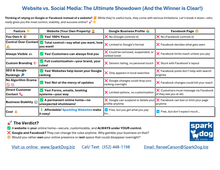
Website vs. Social Media:  The Ultimate Showdown (And the Winner is Clear!)

PDF
Thinking of relying on Google or Facebook instead of a website? 🤔 While they’re useful tools, they come with serious limitations. Let’s break it down—who really gives you the most control, stability, and success online? 🚀👇

Download "Website vs Social Media.pdf"

Why a Facebook Page is Not a Substitute for a Website

Why a Facebook Page is Not a Substitute for a Website
When it comes to promoting and representing your small business online, it's important to have a strong, professional presence. Many businesses today turn to social media platforms, like Facebook, to create that presence. However, using a Facebook page as your primary or only online presence can be a huge mistake. In this article, we'll go over the top ten reasons why using a Facebook page as your business website is a bad idea and explore some alternative options for promoting your business online.


1. You don't own it.

One of the biggest drawbacks to using a Facebook page as your business website is that you don't actually own the page. It belongs to Facebook, and they can change it, remove it, or make it hard to find in search results at any time. This lack of control can be frustrating and potentially damaging to your business, especially if you've put a lot of time and effort into building up your Facebook presence.


2. You eliminate non-Facebook users.

While Facebook has over two billion users, there are still plenty of people who don't use the platform, particularly in younger and older demographics. By relying solely on a Facebook page for your online presence, you risk eliminating these potential customers. While it's true that not everyone uses social media, it's important to consider all potential channels for reaching your audience.


3. SEO options are limited.

SEO, or search engine optimization, is the practice of improving the ranking of a website in search engine results. While it's possible to optimize a Facebook page to an extent, you are limited in the keywords you can target and the content you can post. Additionally, a Facebook page will only show up in search results once, while a website with multiple pages has the potential to show up multiple times. This can make it harder for potential customers to find your business online.


4. You may have to pay for ads to get seen.

Facebook is in the business of making money, and they use a "freemium" model to do it. While creating a Facebook page and posting updates is free, the reach of those posts is often quite limited. In order to get your posts seen by a larger audience, you may have to pay for ads. While this may not be a high cost for some businesses, it's important to factor it into your marketing budget.


5. Functionality is limited.

On a Facebook page, you can post updates, upload photos, and use Facebook Messenger to chat with customers. However, the functionality of a Facebook page is quite limited compared to a website. A website allows you to create forms, add e-commerce functionality, and create custom pages and posts with a wider range of formatting options.


6. There's no sales funnel.

A sales funnel is a series of steps that a potential customer goes through on their way to making a purchase. On a website, you can use calls-to-action, landing pages, and other tactics to guide users through the sales process. With a Facebook page, you don't have the same level of control and therefore don't have the same ability to guide users towards making a purchase.


7. Content is limited.

While it's possible to write an "About Us" section and post updates on a Facebook page, there isn't really a place to post in-depth content that can draw in users and improve your search engine ranking. A website, on the other hand, allows you to create blog posts, articles, and other types of content that can help you attract and keep customers.


8. You can't brand the page.

On a Facebook page, you can add a cover image and upload a profile picture, but you can't really brand the page beyond that. A website, on the other hand, allows you to choose your own color scheme, fonts, and design elements to create a cohesive and professional look.


9. Searching for content is difficult.

On a website, you can save, organize, and make pages and posts searchable. This makes it easy to find and refer back to older content. On a Facebook page, the options for saving and organizing content are much more limited, and there is no way to export your content. This makes it difficult for both you and your customers to find and refer back to older posts.


10. Analytics and data are lacking.

Finally, the analytics and data available on a Facebook page are not as robust as those on a website. While Facebook does provide some information on the reach and engagement of your posts, it's not as detailed or customizable as the analytics you can get from a website. This makes it harder to track the effectiveness of your marketing efforts and make data-driven decisions about your business.


A Facebook business page should be used in addition to a website, not as a substitute for one.

If you want to grow your business online, it's essential to have a professional website in addition to a Facebook page. A website allows you to promote your brand, fully showcase your products or services, create a sales funnel, and track your marketing efforts through detailed analytics. While it may seem easier and cheaper to use a Facebook page as your primary online presence, the limitations of a Facebook page make it a poor choice in the long run.

That's where our web design firm comes in! We specialize in creating affordable, professional websites for businesses of all sizes. Our team of experienced designers and developers will collaborate with you to create a website that perfectly reflects your brand and meets your business goals. And, once your website is up and running, you can use your Facebook page to promote it and drive traffic to your site.

Don't settle for a limited online presence. Invest in a professional website and take your business to the next level. Contact us today to learn more about how we can help your business succeed online.

Why DIY Site Builders are Bad for Small Businesses

Do you need to build a website for your small business and are considering building one yourself?

If you don't yet have one, building a small business website is very important. Unfortunately, many people think that it's something that they can build on their own. Only after making a low-quality website do they realize that they would have been better off leaving it to the professionals.

If you want to find out why building a DIY website is a bad idea for your small business, read on, and we'll tell you what you need to know.


1. It’s Not as Easy as It Appears
There are many programs and platforms whose marketing suggests that building your website is an easy thing to do. They make promises that you can build your website in a day or less without technical knowledge. This is why so many people who do not know how to build a business website choose to take it upon themselves to build one.

Unfortunately, only after investing in software and programs do people realize that it's not as easy to build a small business website as they thought it would be. They get stuck with a half-built website that they don't know how to finish.


2. There Are Always Hidden Fees
No matter what platform you use to build your DIY website, you're going to face hidden fees. One of the most frustrating things that people face when they're trying to design a business website on their own is the expenses that they don't realize they have to pay.

It's easy to get excited when you find a website platform that advertises itself as an all-in-one, easy solution for building a business website. But many people don't realize until after buying a subscription that they also must invest in things like domain names, hosting, and SSL certificates.

Many people also don’t realize they have to renew their subscriptions every year to keep their websites live. And if they help with updates, the fees are high.

These hidden costs add up. In the long run, it's more affordable for most businesses to hire professional help to build their website.


3. You Get What You Pay For
Your business is not going to stand out from the competition if it doesn't have an effective brand. It's hard to have a brand that stands out on your business website when you choose to build it on your own.

The reason for this is that most people who choose to build their website for their small business are not experienced designers. When you do this, it's impossible to make sure that your brand website looks professional and stands out from the rest.

It’s also easy to fall for low prices. Sure, building a website might be slightly less expensive than hiring a professional, but you get what you pay for. Those low prices tend to come with basic features and capabilities that won’t deliver the results you need to grow your business online.


4. It’s Easy to Waste Time Learning to Navigate New Platforms
Even if tools such as website builders make it easy to drag and drop your needed elements onto a digital canvas to construct elements of your site, there are still many important things that you need to know how to do.

For example, if you choose to build a website on WordPress by investing in a costly theme, you still have to know how to download and install the theme. You also need to know how to navigate the WordPress platform to install add-ons, such as spam blockers and contact forms.

You need the training to do these kinds of things. If you don't yet have the training, you'll have to spend your valuable time learning how to do them before you can even get started building your website.


5. You Won’t Create the Right First Impression
As your business’s most important tool for advertising, you want to make sure that your website is the best that it can be. It's the place where your potential customers will find out about important things, such as your stories, services, products, and where you're located.

This is why, when it comes to your website, first impressions are more important than ever. Before they even navigate beyond the homepage of your website, they're going to form an opinion about your brand. And this is why you must grab their attention within the first couple of seconds that they are on your website.

Professional website designers know exactly how to do this. On the other hand, those who choose to build their own websites will have to find out how to do this through trial and error. In the meantime, they'll lose many valuable leads.


6. You Won’t Have Search Visibility
Most people who are trying to design a business website on their own think that the actual design of the website is all that matters. What they don't realize is that this is only one of many important things that you need to know how to do if you want to build the best possible website.

Something equally important as designing a website is search engine optimization (SEO). Though there are website builders that claim to have SEO tools, these tools are usually very basic. They do not offer the types of features that a small business needs.

Skilled professionals know how to do things, such as writing search-friendly content for the websites they're building. This will make sure that potential customers can find your business online.


7. You Won’t Have Support While Building a Small Business Website
Did you know that those who design their websites spend less than a quarter of their time designing them and more than three-quarters of their time troubleshooting problems that come up? Small business owners who decide to build their websites don't take this into account.

Only afterward, when it's too late, do they realize how difficult it is to find the support they need when technical issues arise. If you're building your website on your own, expect glitches. And be ready to spend endless hours trying to figure out what went wrong.


8. Your Site Won’t Be Optimized
Small businesses need websites that are secure and that have performance speeds that are fast enough to handle high traffic volumes. One of the worst things that can happen to your website is that it crashes at a key moment when you need it the most.

This is why professionals offer technical solutions to these problems by optimizing your website. By hiring a pro, you'll have peace of mind in knowing that your website will be dependable. You'll also have to figure out confusing details, such as SSL certificates. 


9. The Site Will Be Costly to Update
Those who are trying to build their own website only realize afterwards how difficult it is to update the site they've made. They make the mistake of thinking that they'll improve their site later by hiring a web designer. The problem is that most web designers will insist that you rebuild your site on the platform they use.

If they had simply had their website designed by professionals from the start, it would have saved them lots of money.


10. Your Time Is Better Spent on Other Things
Chances are that you've got a long list of things that you need to accomplish every day that you show up for work. If you're a small business owner, you should be focusing your energy on growing your business.

If you decide to build your website, you'll be distracting yourself from the things that matter most to you and your business. If you're not trained as a web designer, why spend your time trying to be one?


11. The Pros Do It Better
A web designer who knows what they're doing can take the burden off your shoulders. You'll have less to worry about, since you can put your trust in somebody who has many years of training and experience in building websites.

You'll also save money in the long run because professionals know how to build a website that can convert visitors into paying customers.


Don’t Waste Time Building Your Own Website
If you've been thinking about building a small business website on your own, keep in mind that it's not as easy to do as it might seem. You'll have to pay hidden fees and will have to spend many hours troubleshooting problems that will come up. Why not hire professional help to build your website instead?

If you’re interested in learning more about the advantages of hiring our web design firm, don't hesitate to reach out to us. We're here for anything that you might need.

Why Reputation Management and Online Reviews Are Important in Business

Does your company have a great reputation among consumers? If it doesn't, it could be hurting your business even more than you might realize.

One recent report suggested that a company's reputation can account for more than 60% of its total value. As a result, your business might not be worth as much as it would be worth otherwise, simply because of its reputation.

With all of this in mind, reputation management is going to be of the utmost importance for your company. You need to keep a close eye on your online reviews, including both positive and negative reviews, to make sure your company has the best reputation possible.

Today, we're going to talk at length about what makes reputation management and online reviews so important to your company. Learn all about it below.


People Have Come to Trust Online Reviews in a Big Way

Before people patronize a business, they will usually sneak a quick peek at its online reviews. It doesn't matter if they're looking for a good place to eat dinner or trying to find somewhere to buy a car. They'll use online reviews to guide their decision.

People do this because many of them have come to trust online reviews as much as they trust their family and friends. One survey found that more than 80% of people currently trust online reviews as much as those in their immediate circles.

This alone should illustrate just how important reputation management is going to be for your business. If you don't have great online reviews to show to people, it isn't going to bode well for your business since they may feel like they can't trust you to do right by them.


Positive Reviews Will Make People Feel Good About Patronizing Your Business

When people look up your business and read through the online reviews for it, what are they going to find? This should be the first question you ask as part of your reputation management push.

If you see that they're going to come across nothing but positive reviews for the most part, it'll be a great sign. People are going to feel good about using your company's products and/or services when it seems like you've provided other people with wonderful experiences.

Your ultimate goal should be to rack up as many positive reviews as you possibly can over time. It's going to give your business a good reputation and make more people want to patronize it.


Negative Reviews Will Make People Think Twice About Using Your Business

If people don't see one positive review after another when they read through online reviews for your business, it could doom your company from now on. The more negative reviews that your business has, the less likely people are going to be to call on your company for its products and/or services.

You will want to actively work to reverse this trend ASAP. You should put together a reputation management plan that will include addressing any negative reviews you receive and striving to get more positive reviews to push the negative ones to the bottom of the list.


Negative Reviews Can Provide Your Business With a Big Opportunity

If your company has received some negative reviews in the past, it's obviously not going to be a good thing for your business. But it's also not going to be the end of the world.

You should look at these negative reviews as opportunities to show how much your company cares about its customers. It would be worth responding to as many negative reviews as you can so that you're able to make things right with unhappy customers.

If nothing else, this will show other people that you run a company that does its best to make things right when customers aren't satisfied. This could yield positive results for your business reputation in the end.


No Online Reviews Could Be as Bad as Negative Reviews for Your Business

If you find that your company doesn't have many small business reviews at all, this could be almost as bad as having a bunch of negative reviews. It's going to make it appear as though you haven't done enough to give people a reason to leave positive reviews for you yet.

It might also make it seem as though your small business is just getting off the ground, even if that might not necessarily be the case. You should start to encourage your customers to leave reviews for you so that you're able to build up a collection of them over time.


It Doesn't Have to Be Difficult to Manage Your Business Reputation

Reputation management feels like such a tall task to many small business owners. They aren't sure where they should start when it comes to monitoring their reputation and working to improve it.

If you fall into this category, our firm offers reputation management services to small and medium-sized businesses. We'll work to get your business the online reviews that it deserves and ensure that your reputation is every bit as good as it should be.


Call on Us to Assist You With Reputation Management

Do you need a hand with reputation management? If so, our company can provide you with the services that you need to improve your business reputation by leaps and bounds.

You'll be able to make your business reputation better over time by using online reviews to your advantage. It'll work wonders for your business and require very little effort on your part.

Get started today by contacting us to learn more about our reputation management services.